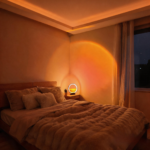
When people think about sleep problems, they usually focus on stress, habits, or screen time.
But there is one factor that often gets ignored because it feels too simple:
the physical environment you sleep in.
In reality, your bedroom conditions—especially temperature, air quality, and overall environment—have a direct impact on how deeply you sleep.
Even if your routine is perfect, a poorly optimized environment can quietly reduce sleep quality night after night.
Why temperature is one of the strongest sleep signals
Your body follows a natural temperature rhythm across the day.
In the evening, your core temperature gradually drops. This drop is one of the biological signals that tells your brain it is time to sleep.
If your room is too warm, this process is disrupted.
You may still fall asleep, but:
- sleep becomes lighter
- deep sleep stages are reduced
- night awakenings become more likely
On the other hand, a slightly cooler environment helps the body transition more naturally into deep sleep.
Most people sleep better when the room feels cool, but comfortable—not cold.
Air quality affects sleep more than most people realize
While temperature is obvious, air quality is subtle—but just as important.
Dry air, poor ventilation, or dust accumulation can lead to:
- throat dryness
- nasal discomfort
- light snoring or breathing interruptions
- restless sleep without clear waking moments
You may not notice these disruptions consciously, but your body does.
Over time, this results in lower sleep efficiency and reduced recovery.
Why humidity balance matters
Humidity plays a key role in how comfortable your breathing feels at night.
If the air is too dry:
- airways become irritated
- sleep becomes fragmented
- morning fatigue increases
If the air is too humid:
- the room feels heavy or uncomfortable
- sleep may feel “sticky” or restless
The goal is balance—not extremes.
This is why many people use simple humidity control tools to stabilize bedroom conditions.
👉 Common solution:
It helps maintain a more stable breathing environment, especially in dry climates or during winter months.
The role of visual and sensory environment
Sleep is not only physical—it is also sensory.
Your brain continues processing environmental cues even while you are falling asleep.
A cluttered, overstimulating room can subtly keep the nervous system slightly alert.
This is why simpler environments often lead to deeper rest.
Key improvements include:
- reducing visible clutter
- softening lighting in the evening
- removing unnecessary stimulation from the sleep area
Temperature and bedding work together
Room temperature alone is not enough. Your bedding also plays a role in regulating heat exchange.
If you are too warm under blankets, your body struggles to maintain optimal sleep temperature even in a cool room.
If you are too cold, the body may remain slightly alert to compensate.
The best sleep environment balances:
- room temperature
- bedding thickness
- body comfort
When these three align, sleep becomes significantly more stable.
A simple “sleep environment checklist”
Before bed, your environment should feel:
- cool but not cold
- quiet or consistently sound-stable
- dim and visually calm
- breathable and not dry
- free of unnecessary stimulation
You don’t need perfection—just consistency.
How environment ties everything together
Across all sleep factors—stress, routine, food, lighting—the environment is the foundation layer.
Even if you improve habits or reduce stress, an uncomfortable sleep environment can still limit results.
This is why sleep improvement is often more effective when approached as a system:
- lighting (signals timing)
- temperature (supports biology)
- sound (reduces interruptions)
- comfort (reduces physical tension)
- routine (stabilizes rhythm)
When these elements work together, sleep becomes less something you “try to fix,” and more something your body naturally enters.
Final thought
Improving sleep quality is not about finding one perfect solution.
It is about removing small forms of resistance that prevent the body from fully resting.
Among all factors, the sleep environment is often the most underestimated—but also one of the easiest to improve.
When your room supports your biology instead of working against it, sleep stops being a struggle.
It becomes a natural response.