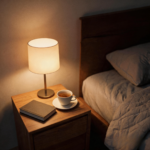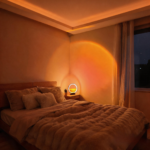
Most people think sleep starts when they lie down in bed.
But in reality, sleep begins much earlier—long before your eyes close.
One of the most overlooked factors influencing sleep quality is something you interact with every day without thinking about it:
light.
Not just brightness, but the type of light your brain is exposed to in the evening.
Your brain reads light as a time signal
The human body has an internal clock called the circadian rhythm.
This system doesn’t rely on watches or schedules. It relies on environmental cues—especially light.
When your eyes detect bright, cool-toned light, your brain interprets it as daytime. It responds by staying alert, active, and mentally engaged.
When light becomes softer and warmer, the brain gradually begins to shift into rest mode.
This transition is not instant. It is a biological process.
And ambient lighting plays a central role in how smoothly that transition happens.
Why harsh lighting disrupts sleep preparation
Modern indoor lighting is often designed for visibility, not biology.
Bright ceiling lights and cool white LEDs keep the environment visually clear—but they also keep the nervous system slightly activated.
Even if you feel physically tired, your brain may still interpret the environment as “daytime,” delaying the release of melatonin, the hormone responsible for sleep regulation.
This is one reason many people struggle to feel sleepy at night, even after long, exhausting days.
It is not always stress or habits—it is often light exposure.
The role of melatonin (and why timing matters)
Melatonin is often called the “sleep hormone,” but its role is more subtle than simply making you sleepy.
It signals to your body that it is time to reduce alertness and prepare for rest.
However, melatonin production is highly sensitive to light exposure.
- Bright or blue-toned light suppresses it
- Warm, low-intensity light allows it to rise naturally
This means the lighting in your home during the evening can directly influence how easily your body transitions into sleep.
Why ambient lighting works differently
Ambient lighting is not about darkness. It is about soft control of visual stimulation.
Unlike overhead lighting, ambient light:
- reduces contrast in the environment
- removes sharp brightness from the visual field
- creates a more gradual transition between day and night
This subtle difference matters more than most people realize.
When your environment becomes visually softer, your brain does not need to stay in a “high alert” state to process incoming light information.
Instead, it slowly shifts toward rest.
The importance of emotional perception of light
Sleep is not only biological—it is also psychological.
Your brain associates certain environments with certain emotional states.
Harsh lighting is often linked to:
- work
- productivity
- alertness
- stimulation
Soft ambient lighting, on the other hand, is often associated with:
- relaxation
- rest
- safety
- calmness
This emotional association reinforces the biological signal.
So when you adjust lighting, you are not only changing brightness—you are changing how your brain feels about the environment.
Why many people struggle with nighttime overstimulation
One common modern pattern is:
- bright indoor lighting
- followed by phone or screen exposure
- then suddenly trying to sleep in darkness
This creates a sharp contrast between stimulation and rest.
The nervous system does not transition smoothly—it shifts abruptly.
That’s why many people feel “tired but not sleepy.”
A gradual reduction in light intensity helps bridge this gap.
How to create a better lighting transition at night
Instead of switching directly from bright lights to complete darkness, a more natural approach is to gradually reduce stimulation.
For example:
- dim overhead lighting after sunset
- switch to warm-toned light sources
- avoid bright white lights in the evening
- create a softer visual environment in bedrooms and living areas
This gradual shift better aligns with your natural circadian rhythm.
A simple way people apply this in real life
Many people create a “light transition zone” in their home during evening hours.
Instead of treating lighting as binary (on/off), they treat it as a scale:
- bright (daytime)
- medium (early evening)
- soft warm glow (pre-sleep)
This final stage is where ambient lighting becomes most useful.
👉 One commonly used option for this stage is:
It is often used not as decoration, but as a way to simulate natural sunset lighting indoors—helping the brain recognize that the day is ending.
Why better lighting often improves sleep without effort
What makes lighting powerful is that it works passively.
You don’t need to “try” to benefit from it.
Once your environment becomes more aligned with natural light patterns, your body begins adjusting automatically.
People often notice:
- falling asleep faster without forcing it
- feeling calmer in the evening
- less mental “restlessness” in bed
These changes are not dramatic—but they are consistent.
Final thought
Ambient lighting does not directly “cause” sleep.
Instead, it shapes the conditions that allow sleep to emerge naturally.
When your evening environment becomes softer, warmer, and less visually demanding, your nervous system receives a clear signal:
It is safe to slow down.
And once that signal becomes consistent, sleep tends to improve in a more natural and sustainable way.